
Pongal
பொங்கல்
Tamil Nadu's four-day harvest festival, thanking the sun, the land and the cattle with pots of freshly boiled pongal.
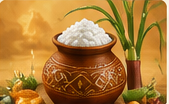
Pongal (பொங்கல்) is the great harvest festival of the Tamil people, and at its heart it is a big thank you. Families thank the sun for its light, the earth for its crops, and the cattle that help on the farm. The word pongal means "to boil over", and the happiest moment of the festival comes when milk and new rice bubble up and spill over the rim of the pot. Wherever you live, it is one of the most joyful festivals to celebrate as a family.
When is it celebrated
Pongal begins on the first day of the Tamil month of Thai (தை), which usually falls on 14 or 15 January. Traditionally, this is the day the sun moves into Makaram (Capricorn). It also marks the start of Uttarayanam (உத்தராயணம்), the sun's "northward journey", which is considered an auspicious half of the year.
The festival is spread over four days:
- Bhogi (போகி) — the last day of Margazhi (மார்கழி), the day before Thai begins
- Thai Pongal (தைப்பொங்கல்) — Thai 1, the main day, dedicated to the sun
- Mattu Pongal (மாட்டுப் பொங்கல்) — Thai 2, honouring cows and bulls
- Kaanum Pongal (காணும் பொங்கல்) — Thai 3, a day for visiting family and friends
A much-loved Tamil saying goes "Thai piranthaal vazhi pirakkum" (தை பிறந்தால் வழி பிறக்கும்) — "when Thai is born, a way will open". It captures the hope people feel as the new month begins.
Why it is celebrated
Pongal comes after the main rice harvest in Tamil Nadu, when farming families can rest and give thanks. Unlike many festivals, it is not built around a single legend. Instead, it honours the things that make a harvest possible: the sun, Suriyan (சூரியன்), for helping the crops grow; the rain for watering them; and the cattle for ploughing the fields and giving milk.
Because it celebrates the land that everyone depends on, many people see Pongal as a festival for all Tamils: a celebration of gratitude, hard work and sharing.
How families celebrate
Bhogi
On Bhogi, homes are cleaned from top to bottom and old, unwanted things are cleared out. In the past, some of these were burned in a small bonfire at dawn, following the old idea "pazhayana kazhithalum puthiyana puguthalum" (பழையன கழிதலும் புதியன புகுதலும்) — letting go of the old and welcoming the new. Today many families skip the fire or keep it tiny, never burn plastic or rubber, and give usable things away instead. By tradition, Bhogi is also linked with Indra, the god of rain.
Thai Pongal
The main day starts early with a fresh kolam at the doorstep. Where possible, the pongal is cooked outdoors in the morning sun, often in a new clay pot (புதுப் பானை) with a fresh turmeric plant, manjal kothu (மஞ்சள் கொத்து), tied around its neck. Everyone gathers to watch, and when the milk froths over the side, they shout together: "Pongalo Pongal!" (பொங்கலோ பொங்கல்!). The pongal is first offered to the sun with sugarcane, bananas and other fruits, and then shared.
Mattu Pongal
On Mattu Pongal, cows and bulls are bathed, their horns are painted in bright colours, and they are decorated with bells, garlands and kumkum. They are fed pongal and fruit as a thank you for their hard work. In some families, girls and women observe Kanu Pidi (கனுப் பிடி) in the morning, placing small portions of coloured rice on a turmeric leaf for crows and other birds, with prayers for their brothers' well-being.
This is also the season of Jallikattu (ஜல்லிக்கட்டு), the traditional bull-taming sport, famous in villages near Madurai such as Alanganallur (அலங்காநல்லூர்). In Tamil Nadu, Thai 2 is also observed as Thiruvalluvar Day (திருவள்ளுவர் தினம்), honouring the poet of the Thirukkural.
Kaanum Pongal
Kaanum means "to see" or "to visit". On this day families visit relatives, go on outings to beaches, parks and riverbanks, and younger people seek the blessings of elders. Around this time, many parents also send Pongal seer (பொங்கல் சீர்), gifts for the festival, to their married daughters.
Traditional food
- Sakkarai pongal (சர்க்கரைப் பொங்கல்) — sweet pongal made with rice, moong dal, jaggery and ghee, finished with cashews, raisins and cardamom. Try our sakkarai pongal recipe.
- Ven pongal (வெண் பொங்கல்) — savoury pongal with black pepper, cumin, ginger, curry leaves and ghee. See our ven pongal recipe.
- Karumbu (கரும்பு) — fresh sugarcane, which children love to chew.
- A festive meal — often served on a banana leaf, with vadai, payasam and vegetables from the new season.
Kolam and decorations
Kolam (கோலம்) are at their grandest during Pongal. Throughout Margazhi, the month before, many women and girls draw a kolam every morning, and on Pongal the designs become bigger and more colourful, with pongal pots, sugarcane, the rising sun and cattle. Kolam drawn with rice flour are traditionally said to share food with ants and small creatures. Mango-leaf garlands, called thoranam (தோரணம்), hang over the door, and bundles of sugarcane and turmeric plants complete the festive look.
Around Tamil Nadu and the world
The same season is celebrated across India under other names: Makar Sankranti in many states, Sankranti in Andhra Pradesh, Telangana and Karnataka, Lohri in Punjab, Uttarayan with kite-flying in Gujarat, and Magh Bihu in Assam.
Tamils in Sri Lanka celebrate Thai Pongal as one of their main festivals, and Tamil families from Malaysia and Singapore to the UK, Canada and Australia keep it alive too. In Canada, January is observed as Tamil Heritage Month, with Pongal at its heart. Families abroad often cook pongal on the stove, face the morning sun, and still shout "Pongalo Pongal!" together.
Some people also call Thai 1 the start of the Tamil year; read more on our Tamil New Year page.
Wishes to share
The classic greeting is "Iniya Pongal nalvazhthukal!" (இனிய பொங்கல் நல்வாழ்த்துகள்!), meaning "Happy Pongal!" Find more greetings in our collection of Pongal wishes in Tamil, or create your own personalised card with the wishes generator.
Published 21 September 2026
You may also like
More festivalsTamil New Year
தமிழ்ப் புத்தாண்டு
Puthandu welcomes the Tamil year on Chithirai 1 with kolam, temple visits, new clothes and a pachadi that holds all of life's tastes.
Sakkarai Pongal
சர்க்கரைப் பொங்கல்
Rice and moong dal slow-cooked with jaggery, ghee and cardamom: the sweet, golden heart of the Thai Pongal celebration.
Ven Pongal
வெண்பொங்கல்
Soft, savoury rice and moong dal tempered with ghee, black pepper, cumin, ginger and cashews: a comforting Tamil breakfast.