
Lord Murugan
முருகன்
Meet Murugan, the young Tamil god of courage and wisdom, with his shining Vel, his peacock and his six sacred abodes.
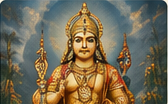
Few gods are as close to Tamil hearts as Murugan (முருகன்). Lovingly called Tamil Kadavul, "the god of the Tamils", he is pictured as a bright, youthful warrior who holds a spear, rides a peacock and watches over the hills. His name is often explained as "the beautiful one", from the old Tamil word murugu, which carries the sense of beauty and youth. For families everywhere, Murugan is a brave protector and a gentle teacher of wisdom.
Who is Murugan?
According to tradition, Murugan is the son of Lord Shiva and Goddess Parvati, and in Tamil tradition he is the younger brother of Ganesha. The Puranas tell that he was born from six sparks of light from Shiva's third eye. The sparks were carried to a lotus pond called Saravana Poigai (சரவணப் பொய்கை), where they became six baby boys. Six Karthigai maidens cared for them, and when Parvati embraced all six, they became one child with six faces.
He was born to defeat Surapadman (சூரபத்மன்), a powerful asura who was troubling the gods. The Kanda Puranam (கந்த புராணம்), the Tamil retelling of the Skanda Purana by Kachiappa Sivachariyar, describes the great battle at Thiruchendur by the sea. Struck by Murugan's Vel, Surapadman split in two, and by Murugan's grace the two halves became a peacock and a rooster: his vehicle and the emblem on his flag.
Murugan's place in Tamil life is very old. The Tolkappiyam, the oldest surviving Tamil grammar, links the god Seyon (சேயோன்), "the red one", with the hilly Kurinji (குறிஞ்சி) landscape, and Seyon is widely understood to be Murugan. That is one reason so many of his temples stand on hilltops.
Names and forms
Each of Murugan's many names tells part of his story:
- Karthikeyan – the child raised by the Karthigai maidens
- Arumugan / Shanmugan – the one with six faces
- Saravanan – born in the Saravana pond
- Senthil – the Lord of Thiruchendur
- Dandayuthapani – his form at Palani, holding a staff and dressed simply as a renunciant
- Swaminathan – his form at Swamimalai, where he became the teacher of his own father
Murugan is often shown with his two consorts. Valli (வள்ளி) was the daughter of a chief of the hill people, and Deivanai (தெய்வானை) was the daughter of Indra, king of the gods.
Symbols and what they mean
- The Vel (வேல்) – According to tradition, his mother Parvati gave him this divine spear. A popular explanation says its broad blade stands for wide knowledge, its long shaft for deep understanding, and its sharp tip for a clear, focused mind.
- The peacock (மயில்) – a proud, beautiful bird that carries the Lord, often seen as a reminder that pride should be tamed and put to good use.
- The rooster flag (சேவல் கொடி) – the rooster crows at dawn, announcing light after darkness.
Many pictures of Murugan carry the words Yaamirukka bayamen (யாமிருக்க பயமேன்): "Why fear, when I am here?"
The six abodes (Arupadai Veedu)
The Arupadai Veedu (அறுபடை வீடு) are six especially sacred Murugan temples in Tamil Nadu:
- Thiruparankundram – near Madurai – a rock-cut hill shrine where, according to tradition, Murugan married Deivanai.
- Thiruchendur – Thoothukudi district – the only one of the six by the sea, where Surapadman was defeated.
- Palani – Dindigul district – a hilltop temple to Dandayuthapani, linked with the story of the fruit of wisdom.
- Swamimalai – near Kumbakonam – where, tradition says, young Murugan explained the meaning of "Om" to Shiva.
- Thiruthani – Tiruvallur district – where Murugan is believed to have married Valli and rested, calm and peaceful, after the battle.
- Pazhamudircholai – near Madurai – a forested hill, linked with the story of Avvaiyar and the cowherd boy.
Festivals
- Thaipusam – in the month of Thai, on the Pusam star day, usually near the full moon. Devotees carry milk pots (பால் குடம்) and the decorated kavadi (காவடி) to fulfil vows, a custom linked to the legend of Idumban, who carried two hills on a pole across his shoulders. Tamil communities in Malaysia, Singapore and Mauritius celebrate it on a grand scale too.
- Kanda Sashti – six days in the month of Aippasi, starting the day after the new moon. It ends with Soorasamharam (சூரசம்ஹாரம்), the re-enactment of Surapadman's defeat, most famously at Thiruchendur.
- Vaikasi Visakam – Murugan's birth star, Visakam, in the month of Vaikasi.
- Panguni Uthiram – a day of divine weddings, celebrated with great joy in Murugan temples.
Every month, the Karthigai star day and Sashti, the sixth day of the waxing moon, are special for Murugan, and many devotees pray to him on Tuesdays.
Devotional songs and prayers
- Thirumurugatrupadai (திருமுருகாற்றுப்படை) – a Sangam-era poem by Nakkeerar that guides devotees to Murugan's sacred places.
- Thiruppugazh (திருப்புகழ்) – songs by the saint-poet Arunagirinathar, thought to have lived around the 15th century, famous for their dancing rhythms and tongue-twisting word play. One of the best known begins Muththai tharu (முத்தைத்தரு). He also wrote Kandar Anubhuti and Kandar Alankaram.
- Kanda Sashti Kavasam (கந்த சஷ்டி கவசம்) – a prayer by Devaraya Swamigal. Kavasam means "armour", and many families recite it daily for protection, especially during Kanda Sashti.
At temples and festivals you will hear the joyful chant Vetrivel Muruganukku Arogara! (வெற்றிவேல் முருகனுக்கு அரோகரா).
Worship at home
- Keep a picture of Murugan or a small Vel in your prayer corner, and light a lamp in the morning or evening.
- Chant Om Saravana Bhava, or listen to the Kanda Sashti Kavasam together as a family.
- Offer flowers and fruit. Panchamirtham (பஞ்சாமிர்தம்), a sweet mix of banana, jaggery, honey and ghee, is a favourite offering, famously made at Palani.
- Tuesdays, Sashti days and Karthigai star days are good days for a special prayer.
- Children can draw a Vel or a peacock in the kolam (கோலம்) at the doorstep.
Stories to read
- The Fruit of Wisdom – how a single mango led Murugan to Palani. A popular explanation says the name Palani comes from Pazham nee, "You are the fruit".
- Avvaiyar and the Cowherd – the wise poet Avvaiyar meets a clever boy who turns out to be Murugan himself.
Published 21 September 2026
You may also like
More deities & devotionKanda Sashti
கந்த சஷ்டி
Six days of fasting and prayer to Murugan after Deepavali, ending in Soorasamharam, the victory over Soorapadman, at Thiruchendur.
Thaipusam
தைப்பூசம்
A great festival of Murugan on Poosam star in Thai, when devotees carry kavadi and milk pots to Palani, Batu Caves and beyond.
Avvaiyar and the Cowherd Boy
ஔவையாரும் சுட்ட பழமும்
A wise old poet, a cheeky boy in a jamun tree and a riddle about 'roasted fruit'. But who is the boy, really?